
FEATURES
Agentic AI, orchestration
& secure integrations
Intelligence that can reason, retrieve, decide, and act — inside a controlled private environment.
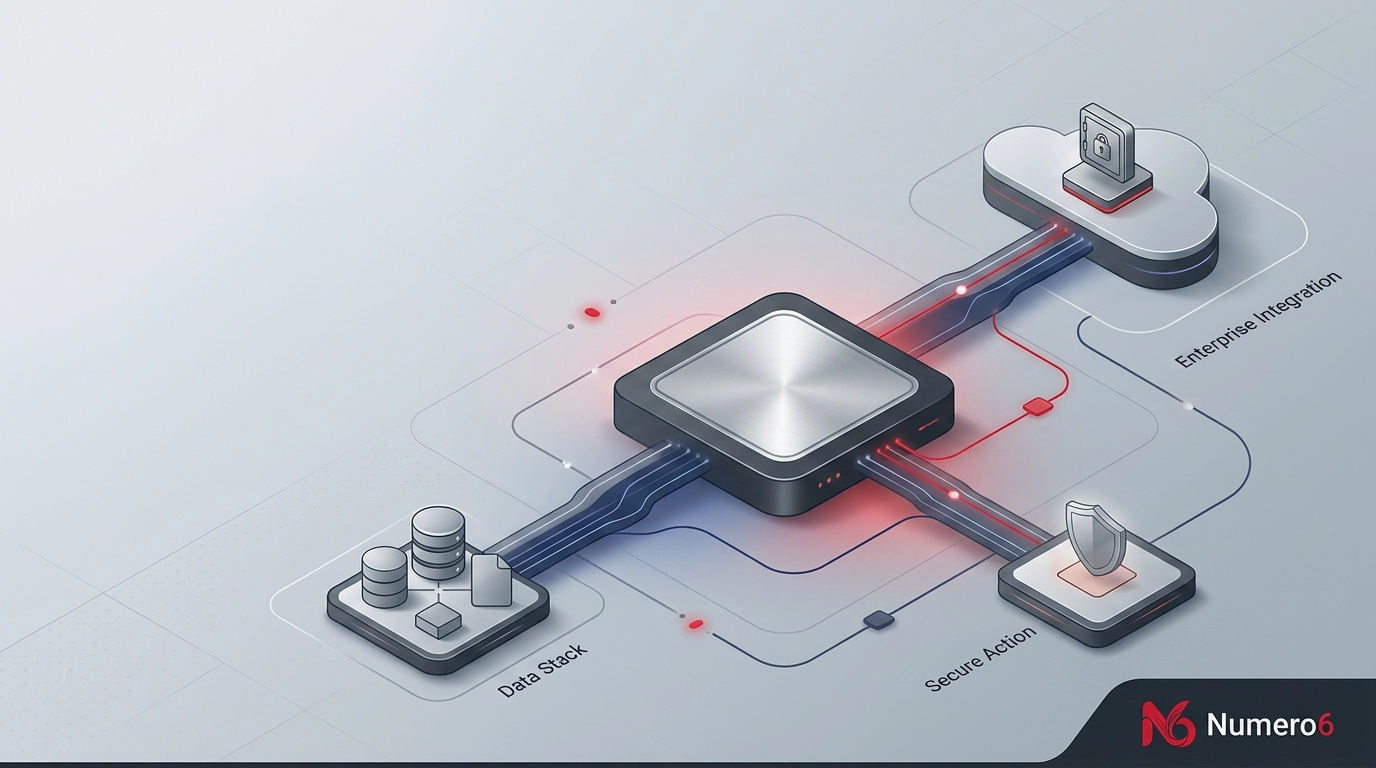
The next frontier of enterprise AI is not the chatbot. It is the operational intelligence layer: an AI system that can understand a request, choose the right tools, gather context, execute multi-step actions, and return a complete outcome instead of a partial answer.
Numero6 enables this through a private agentic runtime built for real business workflows. Tool connectivity is one part of the story, but not the whole story: the platform also supports step-by-step orchestration, retrieval from private knowledge sources, controlled execution flows, stateful conversations, and integration with internal APIs and services. The result is an AI environment that does not simply “talk” to your systems — it can coordinate work across them.
In practice, this means your AI can move from isolated prompts to structured operations: retrieve information, validate it, reason across multiple steps, call external or internal services, generate outputs, and complete a task within defined security boundaries.
Numero6 enables this through a private agentic runtime built for real business workflows. Tool connectivity is one part of the story, but not the whole story: the platform also supports step-by-step orchestration, retrieval from private knowledge sources, controlled execution flows, stateful conversations, and integration with internal APIs and services. The result is an AI environment that does not simply “talk” to your systems — it can coordinate work across them.
In practice, this means your AI can move from isolated prompts to structured operations: retrieve information, validate it, reason across multiple steps, call external or internal services, generate outputs, and complete a task within defined security boundaries.
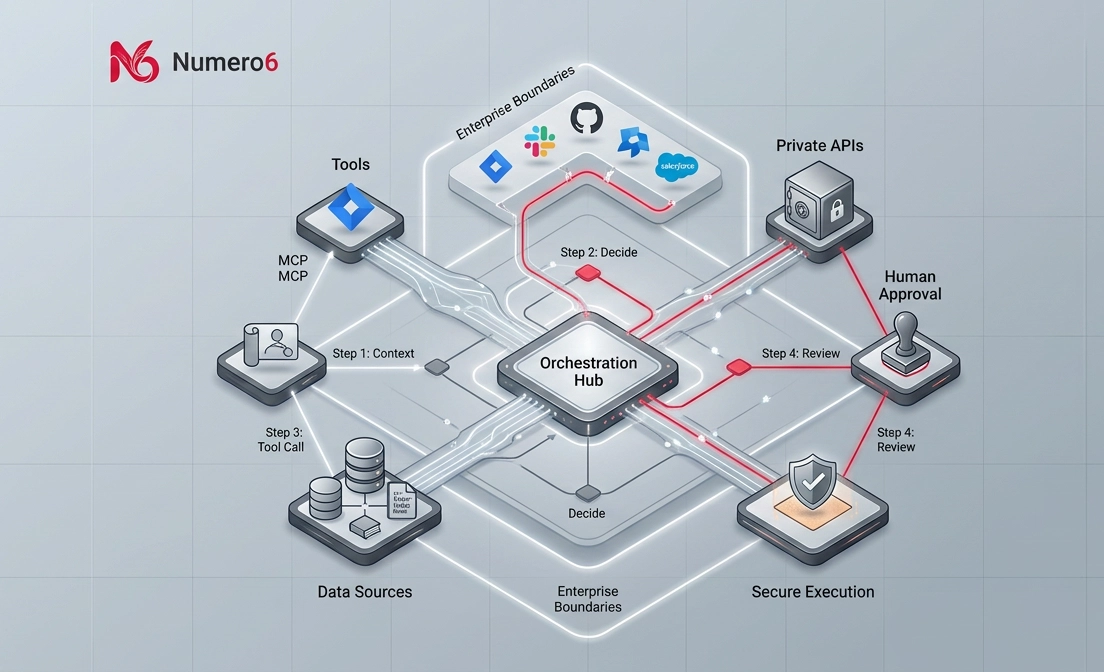
What your AI can do
Connect to tools and business systems — Your AI can interface with internal services, data sources, approved APIs, and operational tools, so it can work with live business information rather than static prompt context alone.
Run multi-step workflows — Instead of producing one-shot answers, the platform can execute a sequence of steps: search, retrieve, analyse, compare, decide, draft, and deliver.
Use private knowledge intelligently — The AI can retrieve relevant content from your documents, knowledge bases, vector indexes, and internal repositories, then use that context inside the reasoning process.
Maintain task state — Complex requests often need continuity. The platform can preserve execution context across steps, so the AI can continue a workflow coherently rather than restarting from scratch at every prompt.
Choose the right action path — Different requests require different flows. The runtime can route a task dynamically: answer directly, call tools, retrieve private context, escalate to human review, or combine multiple actions in sequence.
Work with structured outputs — For operational scenarios, the AI can return validated structured data, summaries, drafts, classifications, reports, and machine-consumable outputs ready for downstream systems.
Apply guardrails and approvals — Sensitive operations can be constrained with explicit permissions, policy checks, and human approval steps before any action is completed.
Execute in a controlled environment — Where enabled, the platform can run code, process data, and automate internal tasks inside bounded and auditable execution environments.
This architecture is especially valuable when the AI operates through private APIs and private infrastructure. The model, the workflow logic, the retrieval layer, and the execution path can all stay within an environment you control.
That enables a stronger security posture:
That enables a stronger security posture:
data remains inside approved boundaries;
access to tools and APIs can be explicitly scoped;
actions can be logged and audited;
sensitive steps can require approval;
retrieval can be limited to authorized sources;
execution policies can be enforced before any action is taken.
For enterprises, this is the key shift: not just AI capability, but AI capability with governance. The platform is designed so intelligence can be operational without becoming uncontrolled.
The value proposition moves from answering questions to completing work. Instead of asking an assistant for isolated outputs, teams can use AI to coordinate repeatable processes across documents, systems, tools, and internal knowledge.
Legal teams can retrieve case material, compare clauses, and draft first-pass notes. Finance teams can pull operational data, reconcile figures, and prepare structured reporting. Operations teams can query live systems, enrich the result with policy knowledge, and trigger approved next steps. All within a private, auditable, enterprise-ready environment.